Call: +255682657464
WhatsApp:+255682657464

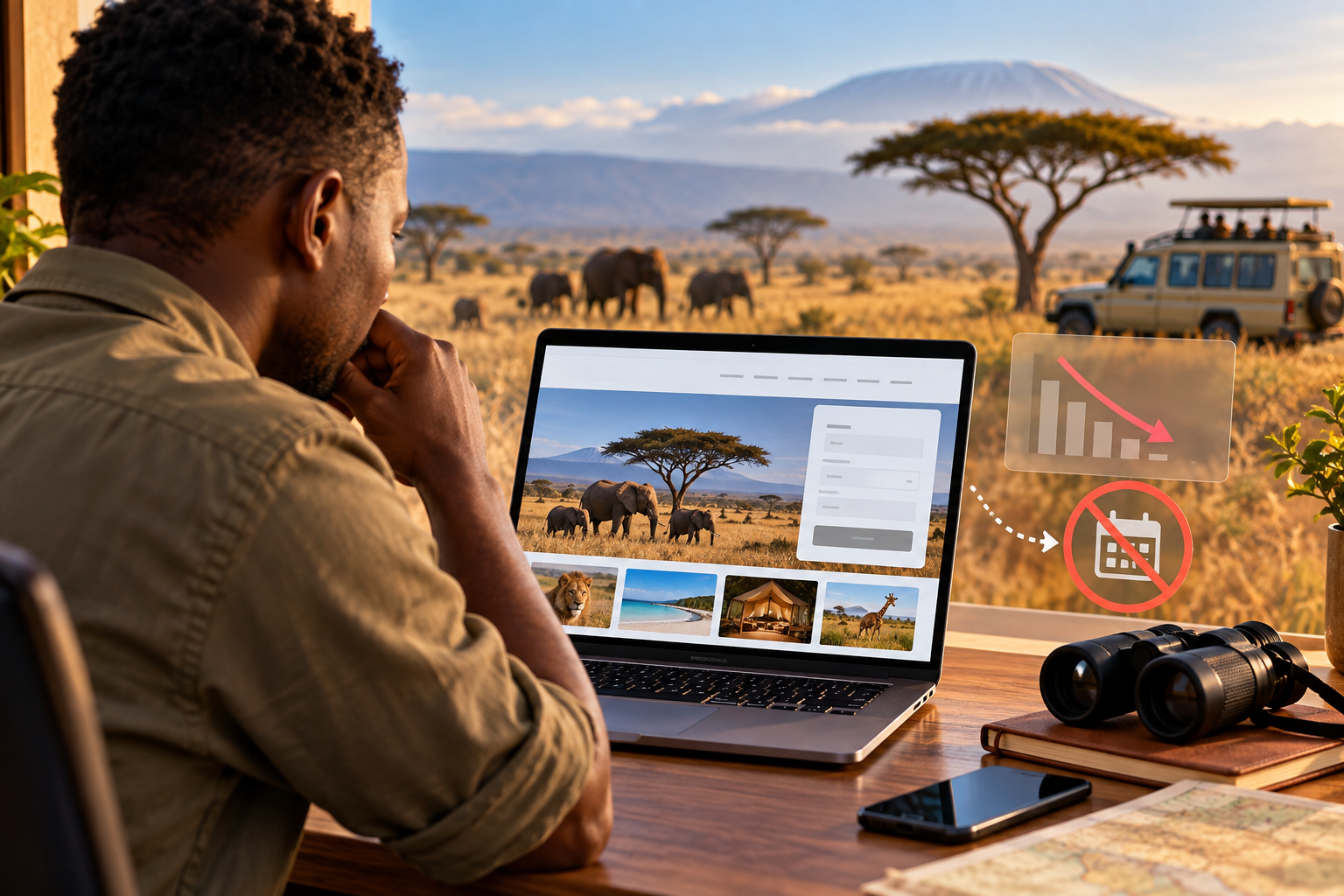
You launched the website. It looks good. Friends said it looks professional. And months later, the enquiries still come from WhatsApp forwards and repeat guests — almost none from the site itself. So the question sits there, quietly: why isn’t your safari website getting bookings?
The honest answer is rarely the one operators expect. It’s not usually the colours, the logo, or the number of photos. It’s that the site was built to satisfy you — the owner — instead of the traveller who was supposed to book through it. That single mistake shows up in a dozen small ways, and together they quietly send ready-to-book visitors to a competitor.
This guide walks through the real reasons safari and tour websites fail to convert in Tanzania, how to tell which ones are hurting you, and what actually fixes them. No jargon, no blame — just the patterns I see again and again across operators in Zanzibar and on the mainland.
A safari website doesn’t get bookings when it puts the operator’s preferences ahead of the traveller’s needs. Every barrier between “I’m interested” and “I’ve booked” costs you a customer — and most sites are full of them without the owner ever noticing.
Here’s the uncomfortable part. When an operator asks me to “make the site look better,” they’re almost always trying to impress themselves and their peers. But your peers don’t book safaris. A stressed traveller in Milan or Munich, planning a once-in-a-lifetime trip on their phone at 11pm, is the only person whose opinion converts into money. If the site works for them, it works. If it only works for you, it doesn’t.
This is the idea that changes everything, so it’s worth stating plainly: your website does not belong to you. It belongs to your clients. You paid for it, you own the domain, but its entire job is to serve the traveller. The moment you build it around what you like — your favourite photo, your long “about us” story, a design that flatters you — you’ve built the wrong site.
Think of it like your safari vehicles. You own the Land Cruiser, but it exists for the guest’s comfort and view, not yours. A website is the same. Own it on behalf of your clients, build every decision around what they need to trust you and book you, and it starts paying you back.
Built for your clients means every element on the page reduces the traveller’s effort, answers their next question, and makes booking obvious. Built for you means the opposite — it showcases the business the way the owner wants to be seen. The gap between these two mindsets is the gap between a site that books and a site that just sits there.
The same budget spent two ways. The left column feels safe to the owner; the right column earns the booking.
Five problems account for almost every safari site that gets traffic but no bookings: speed, language, a confusing booking path, poor visibility, and weak trust. Most struggling sites have three or four of them at once. Here’s how each one quietly kills enquiries — and each is a topic worth fixing properly on its own.
Speed is the silent killer, because a visitor who leaves before the page loads never becomes a statistic you can see. According to Think with Google, the probability that a visitor bounces rises 32% as a mobile page’s load time goes from one second to three, and 123% by the time it reaches ten seconds.
Now picture your real customer: a traveller on hotel Wi-Fi in Europe, or worse, on mobile data while comparing three operators in a taxi. Your gorgeous 4MB homepage hero that loads instantly on your office laptop takes eight seconds on their phone. They’re gone before your logo appears. The fix isn’t a prettier site — it’s a lighter, faster one, with images sized for phones and a build that isn’t dragging ten unused plugins behind it.
A large share of Tanzania’s safari and Zanzibar market is European, and many of those travellers plan and book in their own language. Tanzania welcomed a record 2.14 million international visitors in 2024, and among non-African markets Italy, the United States, France and Germany lead — with Zanzibar alone receiving over 600,000 arrivals, per the country’s 2024 International Visitors’ Exit Survey (NBS and Bank of Tanzania).
Here’s what operators miss: much of Zanzibar’s tourism is owned and run by Europeans selling to European travellers. When an Italian family searches for a Zanzibar tour, an English-only site signals “not for us” — even if they speak some English. A site that greets them in Italian, French or German converts them, because it feels built for them. That’s not translation as decoration; it’s translation as a booking tool. It’s also why real multilingual builds are included in every website I deliver, not sold back as an expensive add-on.
For the practical side — which languages to add first, what to translate, and how to set it up so Google shows each version — see my guide to multilingual safari websites.
Every extra click, unclear button, or unanswered question between interest and enquiry loses travellers. If a guest has to hunt through your menu to find how to book, most won’t — they’ll open the next tab instead.
The most common version of this: a beautiful tour page that describes the Serengeti in loving detail and then… ends. No price range, no “Enquire about this trip” button, no next step. The traveller is ready, and the site gives them nowhere to go. A converting page always answers three things without being asked — what it includes, roughly what it costs, and how to take the next step — with a clear enquiry or WhatsApp button visible on every screen, not just the contact page.
What happens after they press that button matters just as much. My guide to the safari enquiry and quote process covers reply times, quote templates and follow-ups.
A site that isn’t visible in search can’t convert visitors it never receives. This is often the real story behind “no bookings”: there’s no bookings problem yet, because there’s barely any traffic. Travellers find operators through Google and, increasingly, by asking AI assistants like ChatGPT and Google’s AI Overviews “who’s a good safari operator in Tanzania?”
If your site isn’t structured to be found and quoted by those systems, you’re invisible at the exact moment a traveller is choosing. Getting found is a discipline of its own — it’s why getting your safari site found by the right travellers and being recommended by AI tools like ChatGPT and Google’s AI Overviews matter as much as the design itself. A gorgeous site nobody sees earns nothing.
Travellers decide whether to trust a safari operator almost instantly, and a website either confirms trust or destroys it fast. Booking a safari means wiring real money to a stranger in a country you’ve never visited — the fear of a scam is genuine and constant.
Weak trust signals sink otherwise good sites: no real photos of your trips (only stock images), no visible reviews, an empty “testimonials” block, mismatched contact details, or dead links. Strong ones do the opposite — genuine guest photos, real named reviews, clear contact information, secure booking, and proof you’ve done this before. On the sites I rebuild, this is often the single biggest lever. When one Zanzibar operator’s site was rebuilt around the traveller and made findable, it grew from roughly position 31 in search to a peak near 7.8 and passed 5,000 clicks — real people arriving ready to book, not vanity numbers.
Before you spend money on a redesign, find out which of these problems you actually have. Tap each statement that’s true of your site — the check below scores you out of eight and tells you where you stand. Nothing is stored or sent anywhere.
Tap every statement that is true of your website today.
A quick self-audit. A low score isn’t a verdict on your business — it’s a map of the cheapest bookings to win back.
Your website is for the international traveller deciding, often on a phone and often in their own language, whether to trust you with their once-in-a-lifetime trip. Everything on the site should be judged against that one person — not against you, your competitors, or your web designer.
This matters more in Tanzania than almost anywhere. The country is now the World’s Leading Safari Destination at the World Travel Awards, and demand is climbing — but that demand is global. Your buyers are in Rome, Paris, Munich, New York. They can’t visit your office, meet you, or see your vehicles before they pay. The website is the meeting. If it’s built to reassure that specific stranger, you win the booking. If it’s built to please you, you lose it to the operator whose site felt safer.
That’s also why “just design a nice website” is no longer the job. Design is the easy part now — even AI can produce a decent-looking layout in minutes. The hard, valuable work is the strategy: knowing who the traveller is, what stops them booking, how they’ll find you, and how the site earns its keep over years. That’s the difference between a designer and a strategist — and it’s the difference between a site that looks finished and one that actually books.
A safari website has three stages, not one — creation, visibility, and growth — and skipping the last two is why most sites stall. Operators treat the site like a printed brochure: build it once, hang it up, done. But a brochure doesn’t need to be found, and it doesn’t compete every day against everyone else’s brochure.
A site that only got stage one will always underperform, no matter how good it looks — because nobody arrives, or those who do slowly drift to operators who kept improving. This is the whole philosophy behind a safari website built for its full lifespan: treat it as a living asset, not a one-time purchase.
The costs follow the same three stages. A build starts from TZS 1,000,000 (Starter, with your domain and first year of hosting included), rising for booking-enabled and custom sites; visibility and growth come from ongoing search work from TZS 500,000/month or paid campaigns that put you in front of ready-to-book travellers from TZS 350,000/month. If you want the full breakdown, I’ve laid out what a safari or tour website actually costs in Tanzania with real figures.
Fix a non-converting safari website by working through the traveller’s journey in order — findable, fast, clear, trustworthy, bookable — and fixing the first broken link in that chain, not the prettiest one. Here’s the order that returns the most bookings for the least money:
Notice what’s not on this list: a full redesign. Most struggling safari sites don’t need to be thrown away. They need to be re-pointed — away from the owner, toward the traveller. That’s usually faster and cheaper than starting over.
Traffic without bookings almost always means the site loses people between interest and action. The usual culprits are slow loading on phones, no clear price or booking button on tour pages, weak trust signals, and a booking path that takes too many clicks. Visitors arrive interested, hit friction, and leave for a competitor whose site made the next step obvious. Fixing the journey — not the decoration — is what turns those existing visitors into enquiries.
A tour website should show its main content in under three seconds on a phone using mobile data, and ideally under two. Google’s research shows a visitor’s chance of leaving jumps 32% when load time goes from one to three seconds. Since most international travellers browse on phones, sometimes on weaker connections, speed is one of the highest-return fixes you can make — and it usually costs far less than a redesign.
If European travellers book your trips, yes. A large part of Tanzania and Zanzibar’s safari market comes from Italy, France, Germany and other European countries, and travellers trust and book more readily in their own language. A multilingual site signals “this was made for you,” which converts better than an English-only site — even when the visitor speaks some English. Real human translation matters here; rough machine translation can quietly damage trust.
Usually not. A prettier design that’s still built around the owner’s preferences will keep underperforming. Bookings come from a site built around the traveller — fast, clear, findable and trustworthy — which is a strategy question, not only a design one. Design is now the easy part; even AI can produce a good-looking layout. The value is in knowing what stops travellers booking and fixing that, which often means re-pointing your existing site rather than rebuilding it.
It depends on what’s broken. Speed, trust and booking-path fixes on an existing site are far cheaper than a full rebuild. A new professional site starts from TZS 1,000,000, including your domain and first year of hosting, while getting found and growing the site over time runs from TZS 500,000/month. The cheapest first move is often a focused fix of the two or three issues costing you the most — not spending everything on a redesign.
A site stays invisible when it isn’t structured to be found and hasn’t earned enough trust in search — and increasingly, when it isn’t set up to be quoted by AI assistants travellers now ask for recommendations. Visibility is a discipline that compounds over months, not a switch you flip once. If your site gets almost no traffic, you don’t yet have a bookings problem — you have a visibility problem, and that has to be solved first.
You should own it outright. A proper build sits on WordPress you control, with no locked page-builder and no monthly ransom just to edit your own pages. But the more useful way to think about ownership: you own the site on behalf of your clients. Build it for them — the travellers who book you — and that ownership turns into a steady stream of enquiries instead of a bill you keep paying.
If your safari website isn’t getting bookings, the fix rarely starts with how it looks. It starts with who it’s for. The sites that convert are the ones built for the traveller — fast on their phone, clear in their language, honest about price, easy to book, and easy to find. The ones that don’t are built to flatter the owner.
You already own the asset. The question is only whether you’re holding it for yourself or for your clients. Point it at them, treat it as something you grow rather than something you finished, and it starts doing the job you built it for. If you want a second pair of eyes on where yours is leaking bookings, start with an honest look at the numbers — no pressure, just a clear picture.