Call: +255682657464
WhatsApp:+255682657464


A crawl-backed before-and-after of the Eco Pride Africa Tours website: what the old template got wrong, the six moves in the rebuild, the launch checklist, and what any Tanzanian safari operator can copy.
Most safari operators in Tanzania don’t need a prettier website. They need a website that answers the four questions every traveller is silently asking: Where does this trip start? What will it cost? Is this company real? How do I book without being scammed?
Eco Pride Africa Tours and Safaris is a Dar es Salaam operator with a genuine story: private, eco-minded safaris into Southern Tanzania, Mikumi by the SGR train, and a charitable activity built into every trip. Their old website told almost none of that, and parts of it were still the demo content of the template it was built on.
I rebuilt the site. This case study walks through the safari website redesign step by step: what the old site got wrong, what changed and why, what is still on the launch checklist, and the parts any Tanzanian or Zanzibar operator can copy. Every screenshot below is a real capture of the live pages, taken on 12 November 2026 and annotated in the browser. The “page code” panels are read live from each page, not typed in by hand.
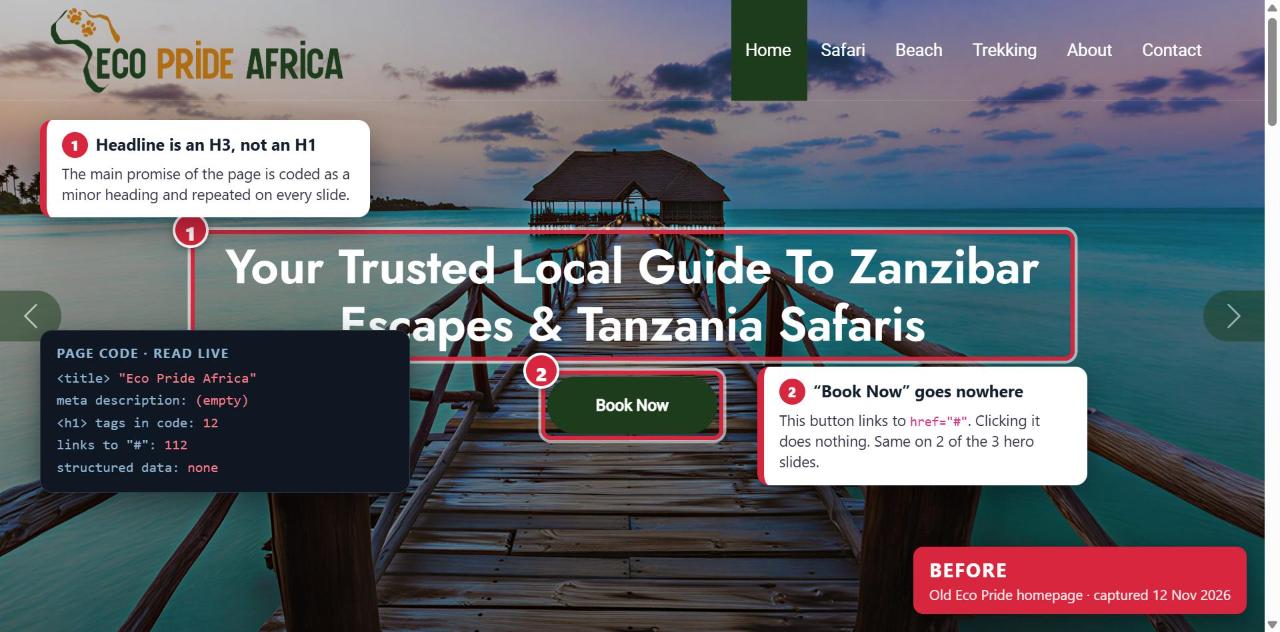
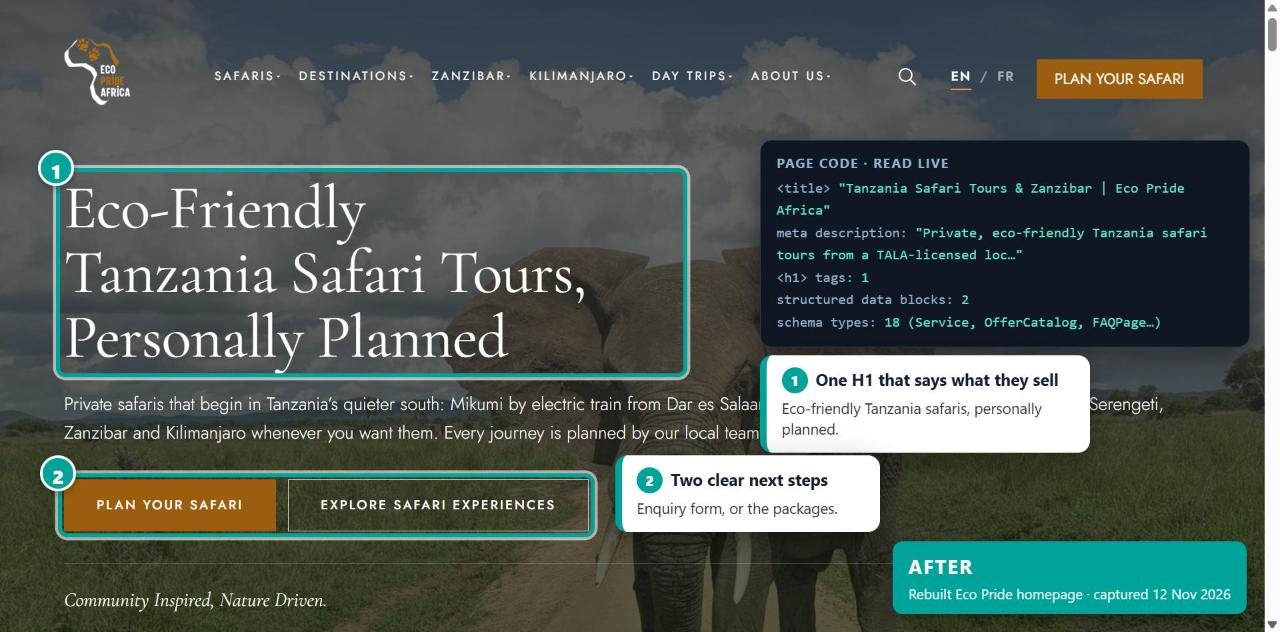
The same homepage, before and after. Tap any screenshot to open it at full size.
The old site was a generic travel template with the company’s logo added, and the template showed through everywhere. I crawled every internal page it linked to: 31 HTML pages in total. The problems fell into five groups.
Of the 31 pages, 24 used the exact same title, “Eco Pride Africa”. The other seven, including the booking, packages, services and testimonial pages, were still titled “Travela – Tourism Website Template”. The title is the blue link a traveller clicks in search results, and it is how a browser tab, a bookmark and a shared link are labelled.
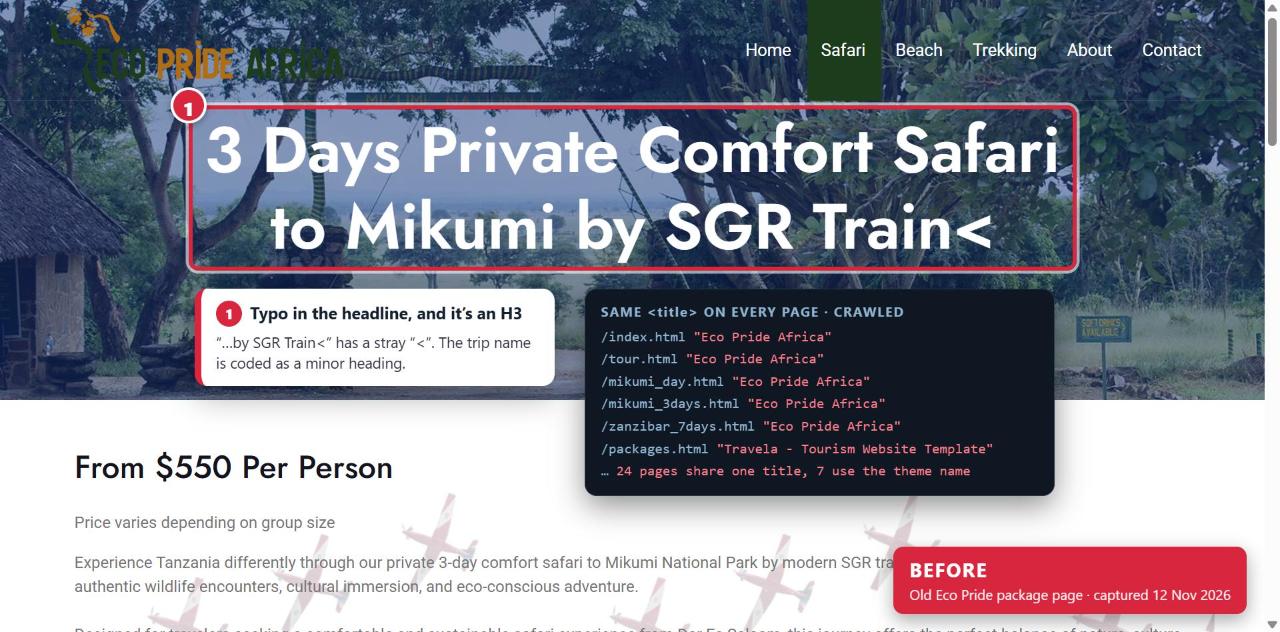
Google’s own guidance on title links asks for distinct text describing each page’s content. A 3-day Mikumi safari and a 10-day Zanzibar holiday that share one name are, to a search engine, the same page twice.
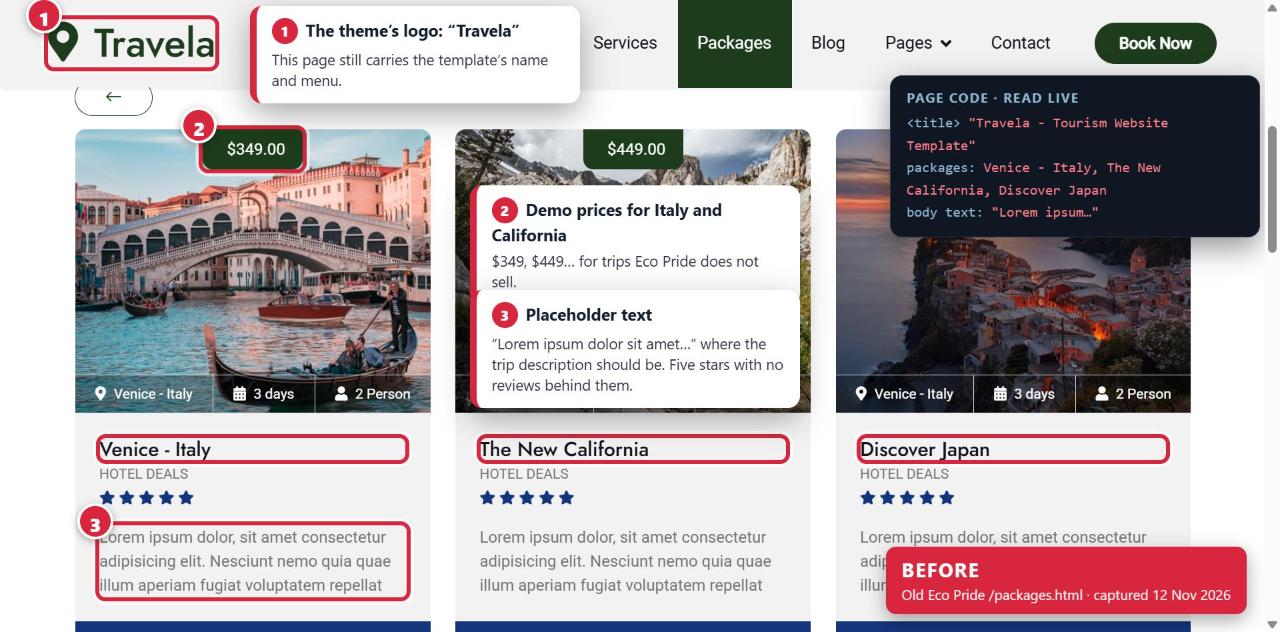
More than anyone would guess from the homepage. The packages page still carried the theme’s logo, “Travela”, and sold demo trips to Venice, California and Japan at $349 and $449, each with five stars and a description that read “Lorem ipsum dolor sit amet”. A traveller who lands there from a search result has one reasonable conclusion: this company isn’t serious, or isn’t real.
The homepage looked cleaner, but its code still held the template’s hidden “International” tab: Australia, Germany, Spain, Japan and London, with “30% Off”, “45% Off” and “70% Off” badges. Visitors couldn’t open it, because no button on the page leads to it, but search engines read it as part of the page.
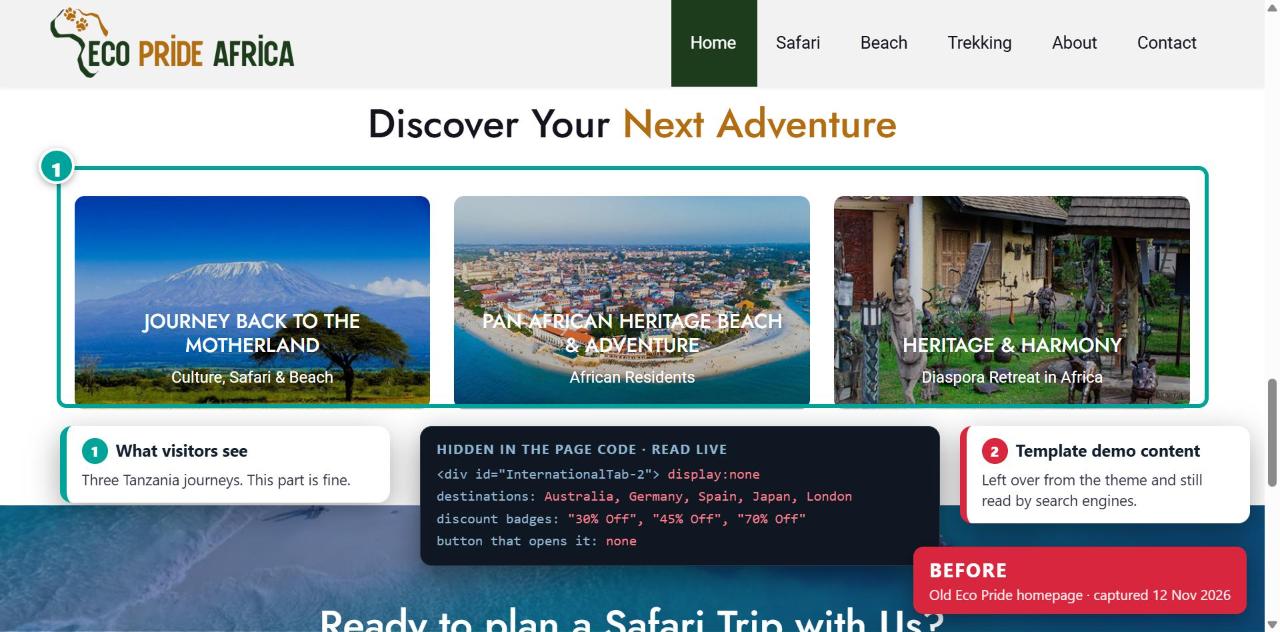
Nowhere, in many cases. The homepage code contained 112 links pointing to “#”, which means a click goes nowhere. Two of the three hero slides had a “Book Now” button that did nothing; you can see one of them in the first screenshot above. In the footer, the email address was coded as an empty link rather than a mailto link, so tapping it on a phone did nothing, there was no tap-to-call number, and “Voice Call” actually opened WhatsApp.
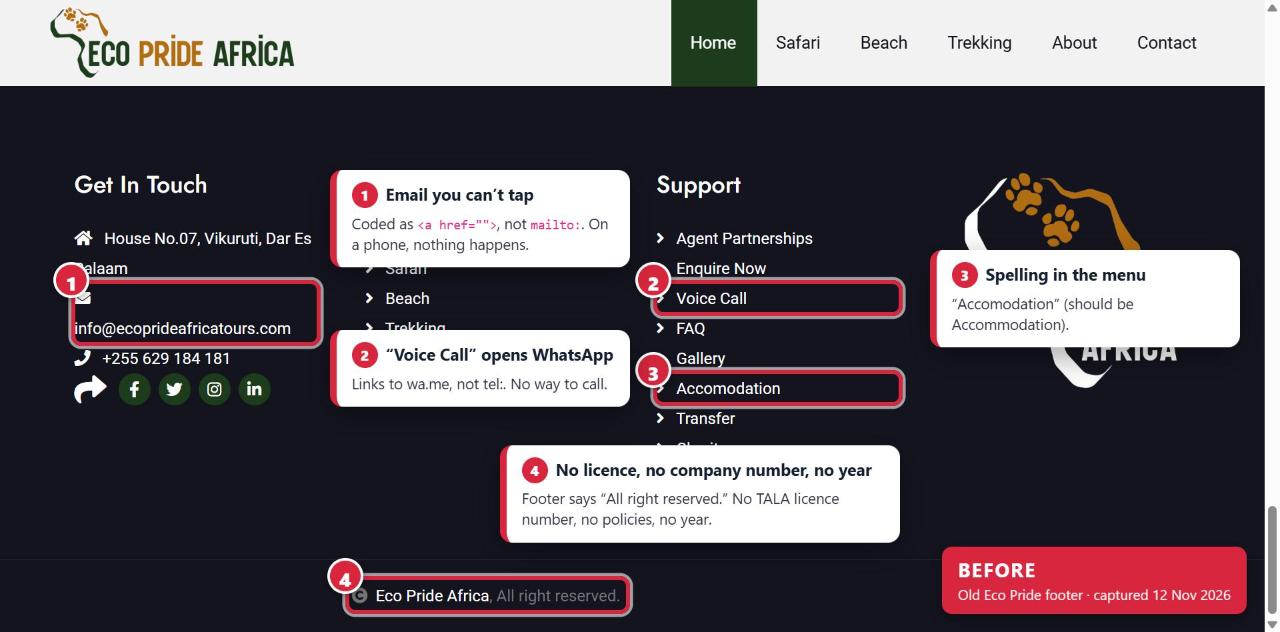
Very little from the homepage. It had about 300 words and no prices at all. The trust signals were three counters (“5,000+ children supported”, “9,000+ trees planted”, “9+ years”) with nothing to back them. There was no licence number, no reviews, no cancellation policy and no payment terms, and the footer said only “Eco Pride Africa, All right reserved.”
Barely. There was no meta description, no structured data, no XML sitemap and no robots.txt file; both of the last two returned “404 Not Found”. Of 69 images in the homepage code, 18 had no alt text and 48 were labelled simply “Image” or “Logo”. The code also contained 12 separate H1 headings, so no single line told a machine what the page was about. Google’s image guidelines rely on alt text to understand what a picture shows; “Image” tells it nothing about Mikumi or the Saadani coast.
The traveller, not the operator. This is the principle behind every decision in the rebuild. Your website is not a brochure about your company; it is a tool your future guest uses to plan a trip that will cost them thousands of dollars, from a country they may never have visited.
The old Eco Pride site was organised around the company: an About section, a mission, statistics. The new one is organised around the questions a traveller asks, in the order they ask them. That is also why so many operators who invest in design still don’t get enquiries; I covered the pattern in detail in why safari websites don’t get bookings.
The stakes are real. Tanzania welcomed 2,294,495 international visitors in 2025, and average spending rose 19.1% to USD 289 per person per night, according to the 2025 International Visitors’ Exit Survey. Higher-spending travellers check more carefully before they pay. Tanzania’s own tourism safety guidance for visitors tells them to confirm an operator’s licence from the Ministry of Natural Resources and Tourism and never to pay into a personal bank account. A website that doesn’t answer those two checks loses the booking to one that does.
Six moves, in this order: position, price, prove, structure, mark up and capture. Design came last, because design is the part anyone can now produce in an afternoon. Strategy is what decides whether the design gets bookings.
The rebuild sequence: each step answers a traveller question before the next one is asked.
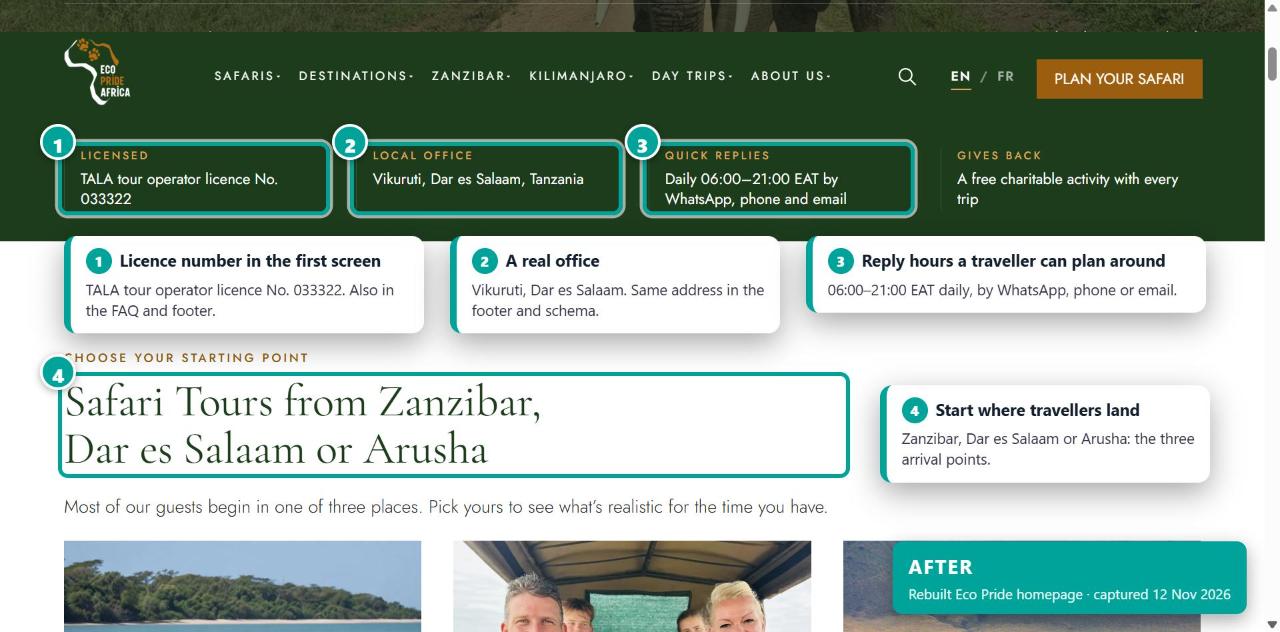
The new homepage opens with one H1: “Eco-Friendly Tanzania Safari Tours, Personally Planned”, followed by a single sentence that names the product: Mikumi by electric train from Dar es Salaam, Nyerere by boat, Ruaha on foot. Directly below, travellers choose where they start: Zanzibar, Dar es Salaam or Arusha.
That choice reflects how people actually arrive. Of international visitors arriving by air, 42.7% land at Zanzibar and 34.3% at Julius Nyerere International Airport in Dar es Salaam, according to TanzaniaInvest’s tourism data. For an operator based in Dar, “Mikumi from Zanzibar” and “Mikumi by SGR train from Dar” are not side products; they are the core offer. The Northern Circuit, Zanzibar and Kilimanjaro are still there, but they support the positioning instead of competing with it.
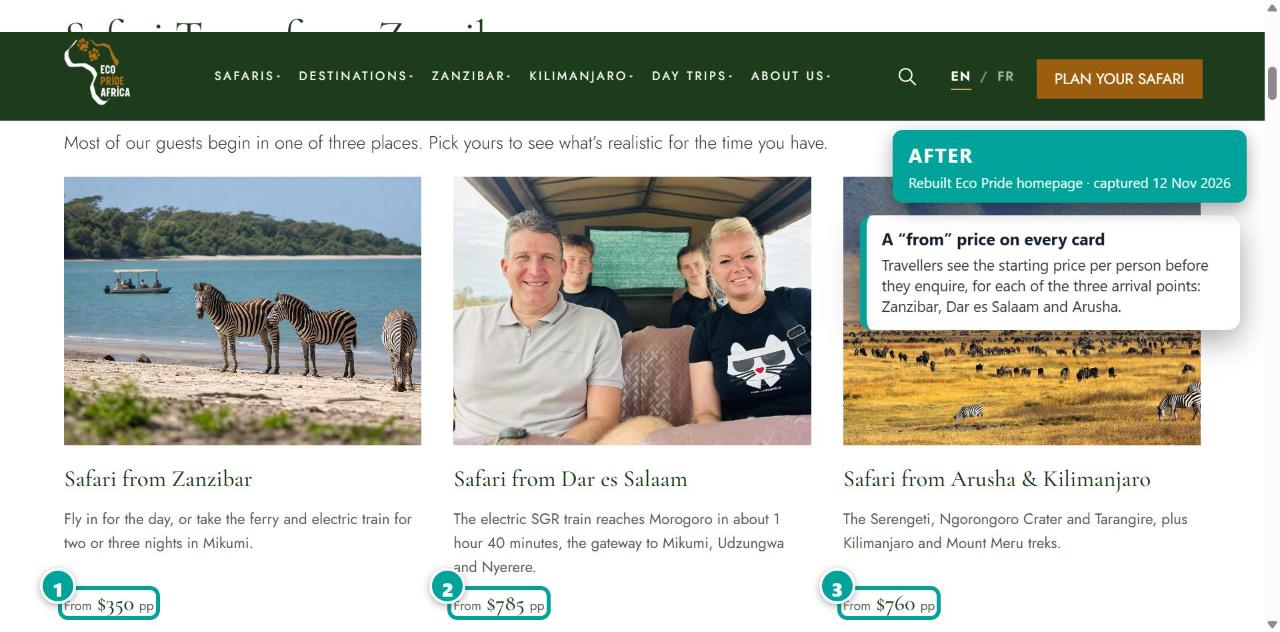
Because a traveller who can’t see a price either leaves or sends a vague enquiry you then have to qualify. The new homepage carries 11 “from” prices, one on every trip card: from USD 350 for a Mikumi safari from Zanzibar, USD 785 for the 3-day private Mikumi safari by SGR train from Dar, and USD 760 for the Northern Circuit from Arusha, through to the signature multi-day packages. A “from” price filters out mismatched enquiries and gives the right travellers the confidence to ask for a quote.
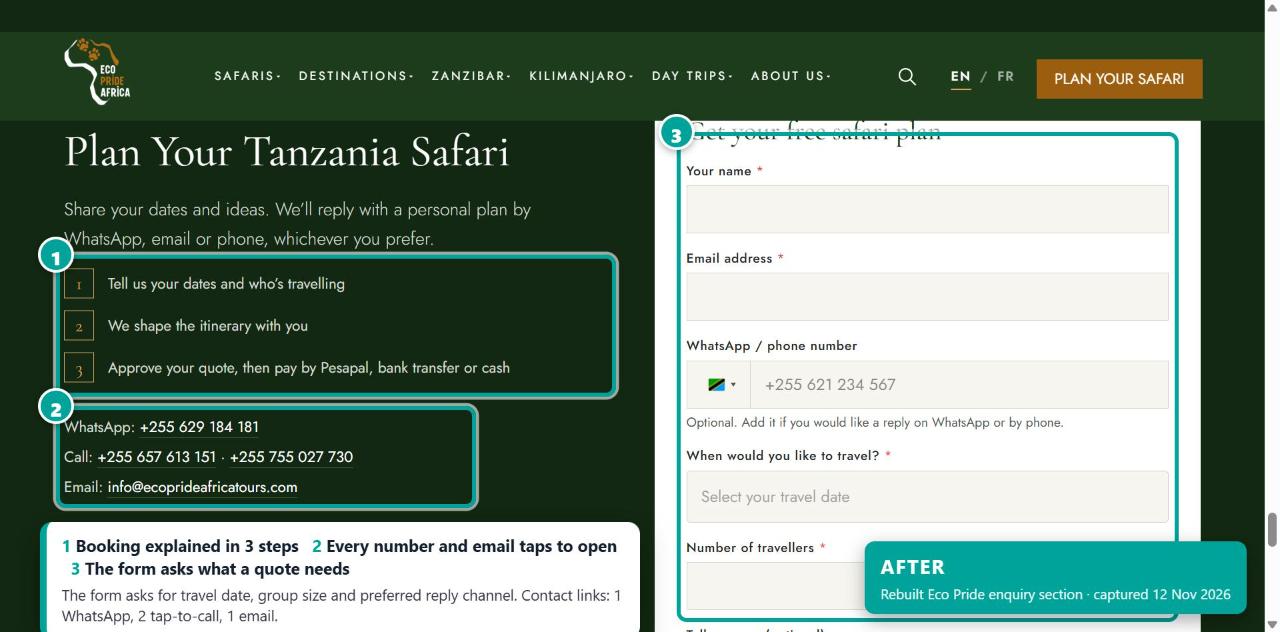
Every route leads somewhere. Contact details are real links: WhatsApp opens a chat, phone numbers dial, and the email opens a new message. The enquiry form asks for what a quote actually needs: travel date, number of travellers, interests and how the traveller prefers to be answered. Next to it, the booking process is spelled out in three steps. A form built that way lets the operator reply with a real quote in the first message, which is where most bookings are won or lost. I set out the full flow after the form in the safari enquiry and quote process.
Because travellers search for specific trips, not for companies. The rebuilt site has 83 published URLs: 26 safari packages, 17 Zanzibar experiences, 9 destination pages, 5 day trips, 4 Kilimanjaro and Meru treks, 2 conservation projects, 3 planning guides and 17 core pages. Every one of the 83 has its own title and its own meta description. A traveller searching “Mikumi safari from Zanzibar” or “Halal-friendly tours in Tanzania” now lands on a page written for exactly that trip. The site also offers a French version, for one of Tanzania’s largest source markets.
It labels your content so machines don’t have to guess. Google explains that structured data gives it explicit clues about the meaning of a page. The new Eco Pride homepage carries 18 schema.org types, including Service, OfferCatalog and Offer for the packages, FAQPage for the questions, PostalAddress and ContactPoint for the business, and a government-issued credential for the TALA licence. The old site had none. This is also what lets AI assistants describe the business accurately when a traveller asks them for a Southern Tanzania operator.
The homepage grew from about 300 words to about 3,350, and none of it is padding. It answers 12 real questions, from “Can I go on safari from Zanzibar?” to “How does the SGR train safari to Mikumi work?”. Three planning guides go deeper: choosing between Mikumi and the Serengeti for a first safari, reaching Mikumi and Nyerere from Zanzibar, and planning a family safari. Dedicated pages serve audiences the old site ignored, including Halal-friendly travellers, families, honeymooners, and the travel trade.
Every measurable signal moved in the right direction. The table compares the two homepages, plus site-wide checks, as crawled on 12 November 2026.
| Check | Old website | Rebuilt website |
|---|---|---|
| Pages with a unique title | 0 of 31 (24 “Eco Pride Africa”, 7 “Travela – Tourism Website Template”) | 83 of 83, each with its own description |
| Homepage title | Eco Pride Africa | Tanzania Safari Tours & Zanzibar | Eco Pride Africa |
| Meta description | None | Written for every page |
| H1 headings in homepage code | 12 | 1 |
| Words on homepage | About 300 | About 3,350 |
| Prices on homepage | None | 11 “from” prices, one per trip card |
| Template demo content | Travela logo, Venice and California packages, Lorem ipsum, hidden foreign destinations | None |
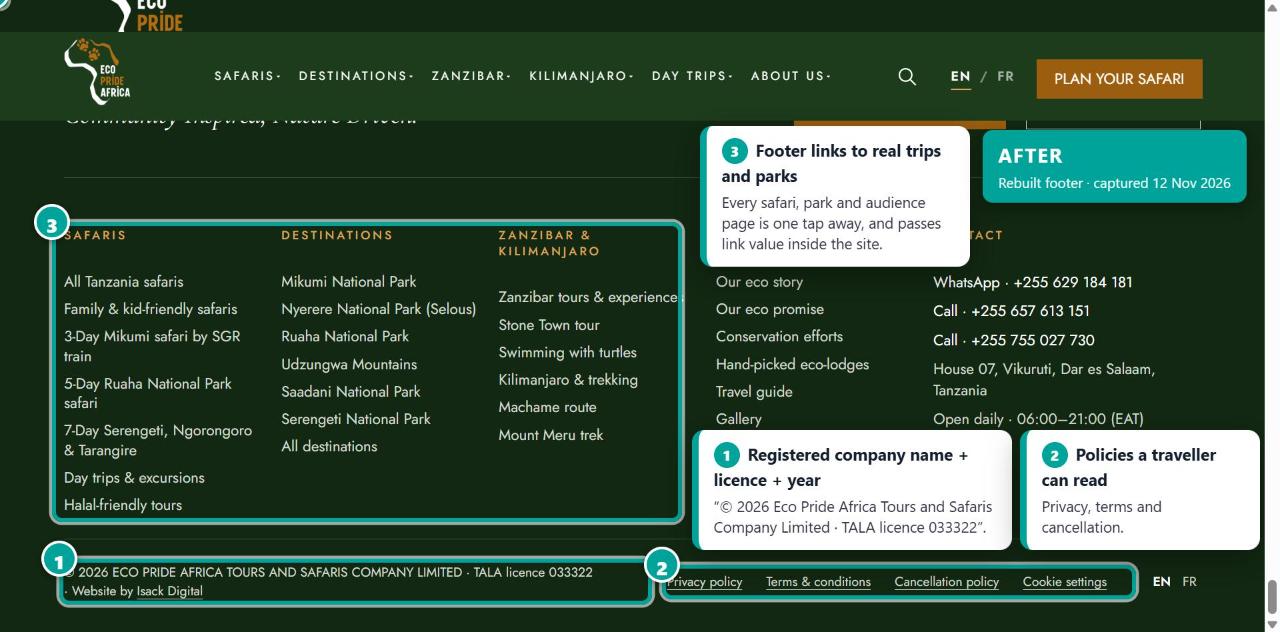
| Licence shown | No | TALA No. 033322 in first screen, FAQ and footer |
| Links to “#” in homepage code | 112 | 0 |
| Email and phone | Email not tappable, no call link | WhatsApp, tap-to-call, email links and enquiry form |
| Images with meaningful alt text | 3 of 69 | 29 of 30 |
| Structured data | None | 18 schema.org types incl. FAQPage and OfferCatalog |
| XML sitemap and robots.txt | Both 404 | Sitemap index, robots.txt pointing to it |
Before-and-after scorecard from a live crawl of the old site and the rebuilt site on 12 November 2026.
Notice what the table doesn’t include: traffic or bookings. The rebuilt site is still in its pre-launch environment and deliberately hidden from search engines until it replaces the old one, so any ranking claim today would be invented. I will publish the post-launch numbers from Google Search Console once there is a fair 28-day baseline to compare against.
A redesign can lose everything the old site had earned if the launch is careless. These are the steps on the Eco Pride launch checklist, and they apply to any operator moving to a new website.
Almost all of it, and most of it costs nothing but decisions. Open your own homepage on your phone and check these seven points.
If you answer “no” to three or more, the website is costing you enquiries. Your top source markets in 2025 were the United States, Italy and France, so the next question is whether those travellers can read your site in their own language; I covered that in multilingual safari websites. For what a rebuild like this costs in Tanzanian shillings, see how much a safari website costs in Tanzania.
A safari website redesign is rebuilding a tour operator’s website around how travellers plan and book, not only changing how it looks. A real redesign revisits the positioning, the page structure, the prices, the trust signals, the enquiry flow and the technical foundations that let search engines and AI assistants read the site. A new colour scheme on the same structure is a reskin. In the Eco Pride rebuild, design came last; the first decisions were what the company sells, to whom, from where, and at what starting price.
Not if the launch is handled properly. Rankings are lost when old URLs disappear without redirects, when the new site is accidentally left blocked from search engines, or when well-performing pages are removed. Before launch, list every old URL, set a permanent 301 redirect from each to its closest new page, remove any pre-launch “noindex” setting, and submit the new sitemap in Google Search Console. Then watch the coverage report for the first few weeks and fix any errors quickly.
Yes. A “from” price per person on each package lets travellers check fit before they enquire, which means fewer vague enquiries and more serious ones. It also builds trust, because hidden prices make international travellers suspect they will be overcharged. Show the starting price, the basis (per person, sharing, season) and what is included, and keep the same figure everywhere it appears. The final quote can still be tailored to dates, group size and lodges.
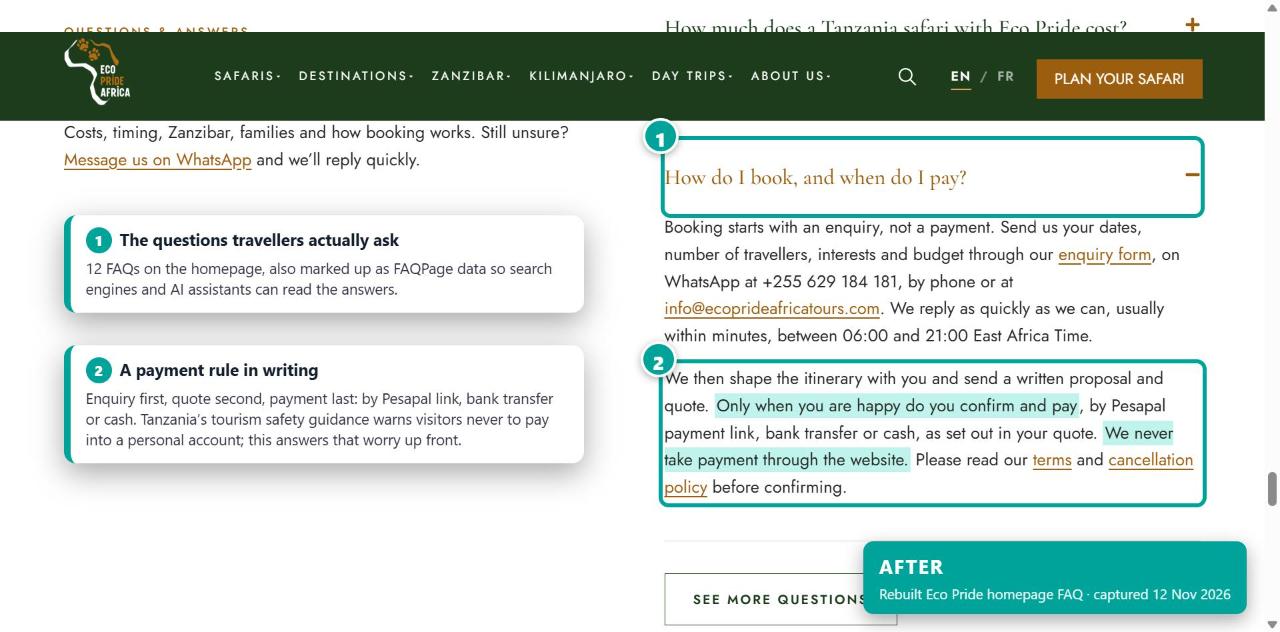
The essentials are your Ministry of Natural Resources and Tourism (TALA) licence number, your registered company name, a physical office address, working hours, and a clear written payment policy that never asks for money into a personal account. Add privacy, terms and cancellation policy pages, and real reviews from past guests. Put the licence number in the first screen and the footer, not only on the About page, because many travellers are told to check it before they pay.
Yes. A traveller searching for “3-day Mikumi safari from Dar es Salaam” wants a page about exactly that trip, with its itinerary, price, inclusions and booking button. When all packages sit on one page, or every page shares the same title, search engines can’t match a specific search to a specific trip. Each package page should have its own title, description, day-by-day itinerary, “from” price and enquiry option.
A template is a fine starting point for layout, but it isn’t a strategy. The risk is shipping it half-finished: demo destinations, placeholder discounts, Lorem ipsum and the template’s name in page titles, all of which the old Eco Pride site had. Those leftovers tell travellers the business isn’t paying attention. Whatever you build on, every page needs content written for your trips and your travellers, and every link needs to go somewhere.
Check three things. First, the first screen: can a stranger tell what you sell and where? Second, the search results: search your company name and a few of your trips and see whether your pages appear with sensible titles. Third, enquiries: if visitors arrive but rarely enquire, or enquire without dates and group sizes, the site isn’t answering their questions. If two of the three fail, a structured audit will show whether you need fixes or a full rebuild.
The Eco Pride Africa Tours safari website redesign wasn’t about a new look. It was about giving travellers what they need to say yes:
Your website is for your guests. Build it so they can use it, and the bookings follow. You can see more of my safari and tourism work in the case studies.
Want the same audit on your safari website?
A Safari Booking Audit checks your website against everything in this case study, from titles and prices to licence visibility and the enquiry flow, and gives you a ranked fix list within 7 days. It starts from TZS 350,000, credited against any build or retainer.


