Call: +255682657464
WhatsApp:+255682657464

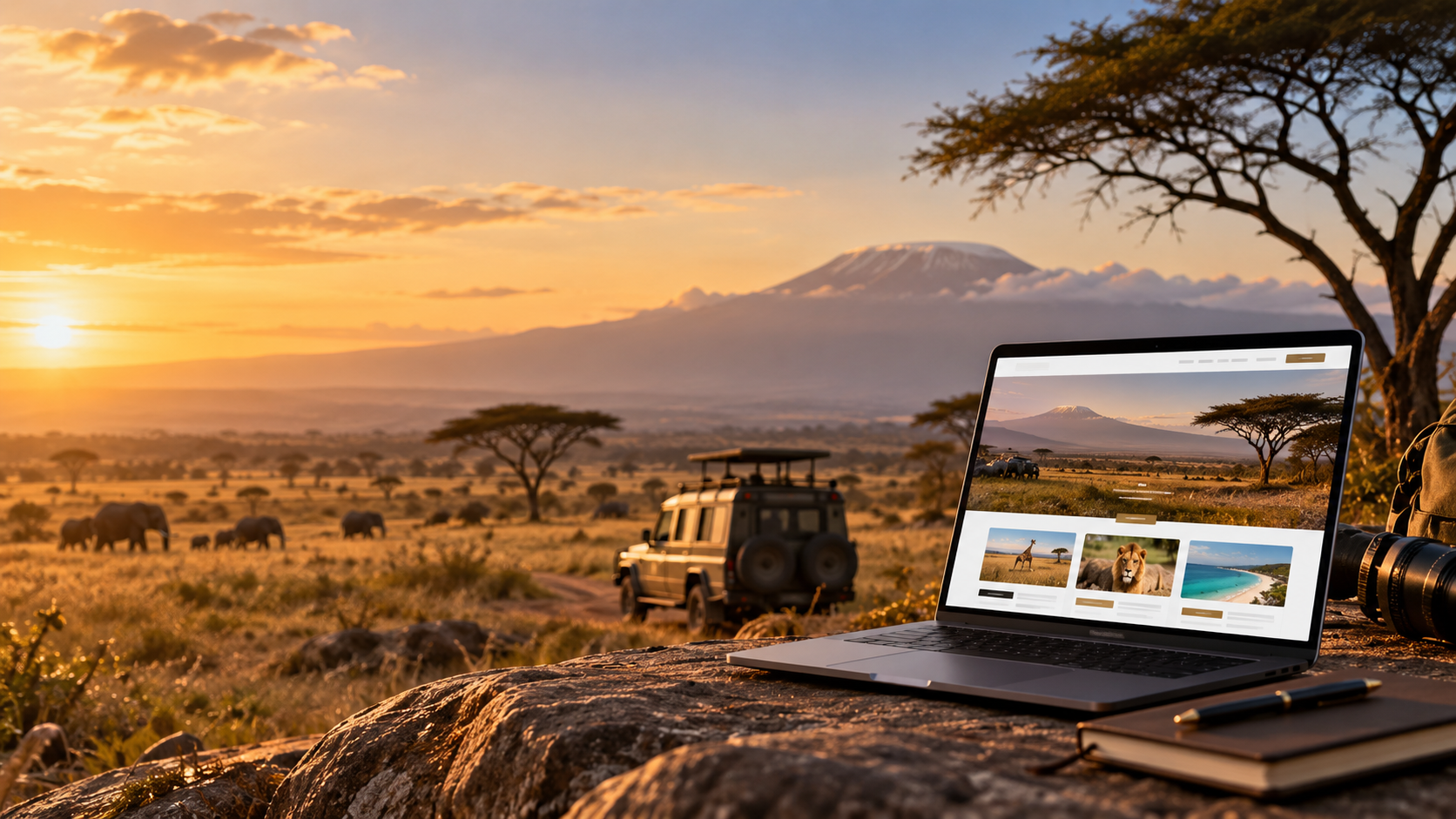
What a safari or tour website costs in Tanzania - real TZS prices by stage, what is included, and why the cheapest option costs the most.
A safari or tour website in Tanzania costs from TZS 1,000,000 to build, from TZS 2,500,000 for a full multi-tour operator site, and from TZS 4,500,000 for a site that takes real bookings and payments. But if that build figure is the only number you are chasing, you are pricing the wrong thing. Design is now the cheap part — AI can push out a good-looking page in an afternoon. What decides whether your site earns bookings is everything around the design: how it is built for the traveller, how those travellers find it, and how it grows over years. This guide breaks down what that actually costs across a safari website’s whole life.
You think the website is yours. It isn’t.
Your website doesn’t work for you. It works for a traveller sitting in London, Munich or Dubai, deciding whether to trust you with three thousand dollars for a trip they can’t see, run by a company they have never heard of, on a continent they have never visited. That traveller is the real owner of your website. It has to answer their questions, calm their fears, and make it effortless for them to book.
Most operators brief a website like a personal possession — my logo bigger, my favourite colour, the pages I like. And they end up with a site that pleases the owner and books nobody — and it’s not rare: when I audited 20 of the market’s ranking safari sites, the same mistakes showed up in the data. The operators who win build the opposite: a site that belongs, in every practical sense, to their clients. Every shilling in this guide is really the cost of building a website your clients own — not one that just has your name on it.
Let me be straight about what you are buying, because it changes how you should judge the price. The design — the layout, the colours, the pretty pages — is commoditised. AI tools and template shops produce it cheaply, and they do. If a website were only design, you would be right to pay as little as possible.
But a safari website isn’t a design project. It is an asset that has to do a job across its whole life: get created properly, get found by the right travellers, and grow into a booking engine year after year. I work across all three — creation, visibility, growth — as one accountable safari & tour website strategist, so the decisions made on day one still make sense two years later. That continuity is the thing AI and the template shops can’t sell you, and it is where the real value — and the real cost — sits.
Priced by the job it has to do, not just the pixels:
| Stage | What it covers | From (TZS) |
|---|---|---|
| Creation — the build | A custom, mobile-first, multilingual-ready site built for the traveller: itinerary pages, enquiry and WhatsApp flows, trust signals. Domain and first year of hosting included. | 1,000,000 |
| Visibility — getting found | SEO and Google Ads that reach travellers in the markets that book Tanzanian safaris — the UK, US, Germany and the Gulf. | 500,000/mo · 350,000/mo |
| Growth — staying ahead | Care, security and speed, plus ongoing content and optimisation so the site compounds instead of decaying. | 100,000/mo |
Build tiers scale with what your clients need: a small operator with a few tours starts at TZS 1,000,000 (Starter, up to 10 pages); a full multi-tour, multilingual operator site is TZS 2,500,000 (Business, up to 50 pages); and a site that takes real bookings and payments — M-Pesa, Selcom, DPO, cards — is TZS 4,500,000 (Custom / e-commerce). Google Ads also carries an ad budget you pay directly to Google, realistically from about $300/month, on top of the management fee. You can see every figure on the pricing page.
Notice that every cost driver below is really a question about your clients, not about you:
The build is once. Serving your clients is ongoing, and any honest quote says so:
.co.tz through tzNIC, a .com through any registrar).The trap in this market isn’t overpaying. It is paying a little for the wrong thing:
Every one of these gives you a website you technically own and your clients can’t use. That is backwards.
Cheaper is always available, and sometimes it is the right call — a brand-new operator testing the water doesn’t need the top tier. But your website runs 24 hours a day in front of people spending real money on trust alone. Spending a little on something that quietly loses bookings is far more expensive than spending properly on something that wins them. Price it by what it has to do for your clients — not by what it costs you to make. If you want to see the approach behind the numbers, this is my work on GoSmart Zanzibar Tours.
From TZS 1,000,000 to build a professional site, including your domain and first year of hosting. But the build is one stage of three — getting found (SEO from TZS 500,000/month) and growing the site over time are what turn it into a booking engine.
Because design isn’t the hard part anymore — AI can do that. The hard part is building a site your clients can actually use to trust and book you, then getting it in front of the right travellers and growing it over time. That is strategy across the site’s whole life, and a template doesn’t give you it.
Yes. Every build includes your domain and the first year of hosting. After that, a care plan from TZS 100,000/month or TZS 1,000,000/year keeps it fast, secure and growing.
Multilingual capability is built into a full operator site (from TZS 2,500,000) at no extra charge. Real human translation into a specific language — German, French or Italian — adds cost, but reaches the European travellers who make up much of the safari and Zanzibar market.
You own the asset outright — built on WordPress you control, no locked builder, no ransom to edit your own site. But the smartest way to think about it: you own it on behalf of your clients. Build it for them, and it pays you back.